
What are Fixed Wing Drones
April 16, 2026
While most of us are familiar with the nimble, stationary agility of multirotors , there is another category of flight that is fundamentally redefining what’s possible in the open sky. Fixed-wing drones offer a significant advantage in aerial efficiency, using wings to generate lift through forward motion, allowing them to stay airborne for hours and cover distances that would leave a traditional quadcopter grounded.
In this comprehensive fixed-wing UAV guide, we’ll explore the sophisticated engineering that makes these machines so remarkably efficient. You'll learn the fundamental mechanics of wing-based flight, discover the primary fixed-wing drone benefits, and see how they are currently revolutionizing industries from precision agriculture to wildlife conservation.
How a Fixed-Wing Drone Differ From Multirotors
To truly appreciate the power of these machines, we have to look at the physics of lift. At the heart of every fixed-wing aircraft is the airfoil — the curved shape of the wings. As the drone moves forward, air flows faster over the curved top than the flat bottom, creating a pressure difference that lifts the craft into the air, where it glides effortlessly.
When we look at fixed-wing vs. multirotor flight, the most significant difference is how they handle energy. A traditional multirotor is essentially a flying battery, using constant power to push air downward just to stay level. It fights gravity every second it is in the air. In contrast, fixed-wing drones use their wings to carry the weight, requiring only a fraction of the energy to maintain forward momentum. This inherent aerodynamic advantage is what makes long-range drone flight possible, as the aircraft converts speed into altitude and distance without draining its power source.
Different Types of Fixed-Wing Drone Designs
Not all drone wings are created equal. The most established category is the traditional fixed-wing design. These drones resemble miniature airplanes and often require a runway or a specialized launcher to reach cruising speed. While they offer the ultimate in long-range drone flight and endurance, they can be challenging to operate in confined spaces where a clear landing strip isn't available.
For those seeking more flexibility, the hybrid VTOL fixed wing represents a massive leap forward. These machines take off vertically like a quadcopter and then transition to horizontal flight once in the air. This eliminates the need for expensive launch equipment while maintaining the massive fixed-wing drone benefits of efficiency and speed. This "best of both worlds" approach is quickly becoming the standard for high-accuracy drone mapping and surveying in rugged, inaccessible terrain where space is at a premium.
Finally, there are small fixed-wing drones designed specifically for portability and ease of use. These compact systems are perfect for the aspiring creator who needs to carry their gear deep into the wild. Whether you need the brute endurance of a traditional wing or the versatile launch of a hybrid system, choosing the right design is about finding the perfect partner for your journey.
Range and Endurance of the Fixed-Wing Drone
The most striking of all fixed-wing drone benefits is the sheer scale of what they can accomplish in a single flight. While most traditional camera drones are limited to 20 or 30 minutes of operation, a fixed-wing aircraft can remain airborne for anywhere from one to eight hours. This endurance isn't just a convenience; it is a fundamental expansion of our creative and professional reach. When you combine this stamina with cruising speeds that often exceed 60 kilometers per hour, you gain the ability to cover vast territories—often ranging from 50 to 200 kilometers—without ever needing to land for a recharge.
This capability makes the platform the undisputed champion for large-scale drone mapping and surveying. Imagine having to map a 500-acre forest or inspect miles of remote pipeline; doing this with a typical multirotor would require dozens of battery swaps and hours of logistical downtime. A fixed-wing drone can complete that same mission in a single, continuous sweep. This level of long-range drone flight ensures higher data consistency and significantly lower operational costs for researchers, farmers, and environmentalists alike.
Practical Applications
The true power of the fixed-wing platform is best seen through its impact on global industries. In precision agriculture, these drones are indispensable. A single flight can provide a detailed multispectral analysis of thousands of acres, helping farmers identify irrigation issues or pest infestations before they become catastrophes. This type of high-efficiency drone mapping and surveying allows for a level of data-driven decision-making that simply wasn't possible with traditional methods.
In environmental conservation, the long-range drone flight capabilities of fixed-wing UAVs allow researchers to track animal migrations or monitor illegal deforestation across remote mountain ranges. Because they can carry sophisticated payloads, including LiDAR sensors for topographical mapping and thermal cameras for search-and-rescue, they provide a comprehensive picture of the environment. While a multirotor might struggle with winds at high altitudes, fixed-wing crafts slice through turbulence, ensuring stable, high-quality data even in challenging conditions.
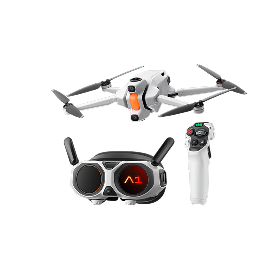
For explorers documenting these environments at closer range, a cinematic multirotor complements large-scale survey data. The Antigravity A1 excels at capturing human-scale storytelling with fluid motion and intuitive FreeMotion control. While fixed-wing drones map the macro world, the A1 captures the emotional perspective inside it, allowing creators to pair scientific coverage with compelling visual narratives.
Is a Fixed-Wing Drone Right for Your Next Project?
Choosing the right aircraft is about aligning technology with your mission. As you weigh fixed-wing vs. multirotor options, consider these critical factors. First, evaluate your environment. Traditional wings require a wide landing strip, while a hybrid VTOL fixed wing can launch and land in tight clearings. If your project involves rugged terrain, the flexibility of VTOL drone technology is almost certainly necessary.
Next, look at the scale of your objective. Are you filming a single mountain bike run or conducting high-accuracy drone mapping and surveying over hundreds of square miles? If your project demands long-range drone flight that exceeds an hour, a fixed-wing platform is the only choice.
Finally, consider your budget and payload. Entry-level systems start around $1,000, but high-end platforms with industrial sensors can easily exceed $50,000. For most creators, a multirotor offers the best balance of portability and storytelling flexibility. But if you are stepping into large-scale research, the efficiency of unmanned aerial vehicle wings is a game-changer.
FAQ
Navigating the world of long-endurance flight often sparks curiosity. Here we address common inquiries to help you decide if these specialized wings are the right fit for your next mission.
Can a fixed-wing drone hover?
Traditional fixed-wing aircraft cannot hover; they must maintain forward speed to stay airborne. However, drones equipped with VTOL drone technology can hover during takeoff and landing. These hybrid VTOL fixed-wing systems provide stationary stability when needed before transitioning to efficient, high-speed forward flight.
How hard is it to fly compared to other drones?
There is a steeper learning curve than with typical multirotors. While we designed the Antigravity A1 with intuitive FreeMotion control for instant ease, fixed-wing systems require an understanding of stall speeds and bank angles. However, many professional systems now include autopilots that handle the technical heavy lifting, making long-range drone flight accessible to dedicated explorers.
Why use this for drone mapping and surveying?
Efficiency is the key. Because unmanned aerial vehicle wings generate lift naturally, they cover significantly more ground per charge. If you need to map hundreds of acres in a single pass, the fixed-wing drone benefits are unmatched. Ultimately, the choice between fixed-wing vs. multirotor depends on your specific goals. We hope this fixed-wing UAV guide helps you plan your next aerial exploration.
Conclusion
By leveraging natural lift rather than fighting gravity with constant rotor power, these fixed-wing drones offer unparalleled efficiency. For those looking to conquer the horizon, these machines provide the endurance required for truly long-range drone flight, making them the premier choice for large-scale drone mapping and surveying.
登録済ですか?
メルマガに登録して、Antigravityの最新情報をメールで受信!

